
(UPDATED JUNE 2024)
There still seems to be A LOT of confusion as to why you should be using Pinterest for your business (blog, creative, small and big). There are numerous reasons why you absolutely should be using Pinterest as part of your business marketing and it makes me cry a little to see so many people pass over this amazing platform for others that don’t give as much return *cough Instagram cough*.
For this post I’m going to outline why Pinterest is brilliant for finding and connecting with your target audience.
It’s worth stating again that Pinterest is not another social media platform. Instead it is an incredibly powerful visual search and discovery engine, kind of similar to Google but much better.
How people use Pinterest
People go to Pinterest at different stages: looking for ideas, saving pins that match those ideas or help visualise what they are looking for. Through to making some kind of action: a purchase, a visit to your website, email signup and so on. For a deeper look at getting action (or conversions) from Pinterest see this post.
Pinterest is an amazing platform where people can go to find small everyday moments- getting a dinner recipe, to big events like organising a wedding and everything in between (tips for starting a business, kid’s bedroom decor, and so much more).
“It’s worth stating again that Pinterest is not another social media platform. Instead it is an incredibly powerful visual search and discovery engine, kind of similar to Google but much better”
How to Find Your Audience on Pinterest
There are actually lots of ways to find your right people on Pinterest. Firstly, I think it’s a good idea to figure out who your audience is. Get really specific about it. I know this may seem scary to get so narrow but we’re not John Lewis. We’re small business owners in our own niches. Of course, we may change as we grow but for the moment it’s really good to be clear about who our ideal customer or reader is.
Who are your ideal audience or customers?
It’s really worth sitting down for an hour and visualising your ideal audience. Maybe even give her a name: does she have a family? What’s her age? What does she do in her spare time (if she has any!)? Or what does she wish she could do if she had spare time? Where does she shop for groceries? Does she like beauty? Does she prefer small batch, handmade beauty products over mass-market products? Is she an ethical shopper? And so on.
Build your ideal audience member all the way up from her core values to her choice of nail polish. Once you have a good idea of who you’re speaking to everything else will become much clearer. I think it’s also important to think about how your product/service will make her feel: is it something she’s dreamed of buying or learning? Will your service or product help her to grow? What is holding her back from finalising the transaction?
Having strong sense of your audience and customer will help you enormously in business.
Show Your Brand Off on Pinterest
If you’re still unsure who your target audience is then think about your own values and how you can expand on them using Pinterest. Are you a minimalist or a maximalist? Environmentally aware? Slow living? Love the high street?
My values, for example, are supporting small business owners (or potential business owners) who either by choice or necessity have found themselves on a different work path to the norm. I want to build authentic relationships and help people grow organically. My blog is about finding the little pleasures in life that just make us happy, no matter how frivolous that may be.
That’s really my core values and from that I can expand that I like coffee shops, nature, photography, ethical shopping etc etc. My ideal audience is similar to me, and that may be the case for you.
Optimise Your Pinterest Account
When you have an idea of who you’re targeting and what you want your brand to portray on Pinterest it’s time to make your Pinterest account reflective of that:

(this is an old photo of my Pinterest profile, have a look at what my Pinterest looks like now here)
If you look at my Pinterest account you’ll see that I’ve moved the most relevant boards to the top so you get a clear indication what I’ll be pinning about. I’ve also made secret the boards that aren’t relevant to my brand but still want to pin on (like healthy eating ideas).
There’s a couple of really good reasons why you should do this, even if you get lots of impressions (but impressions don’t really matter-that’s for another time!).
Firstly, having boards that reflect your brand (that’s your blog or business) let’s Pinterest’s algorithm know what to do with your content – who to push it to and how to categorise it. (It’s not the only signal to Pinterest but it’s one of them).
Secondly, you don’t want to confuse potential customers/readers by having an incoherent account. If you’re a ceramicist it’s probably not ideal to have something like ‘best teeth whitening products’ board. But if you love teeth whitening you can make it secret and still pin all your ideas to it without it affecting your business profile.
Treat your Pinterest like a magazine or an extension of your brand. One of my favourite Pinterest accounts is The Future Kept, they use boards brilliantly:

Having lots of niche boards that relate to your overall brand is excellent for Pinterest SEO plus driving traffic to your site. But that’s for another time though! (Or you can sign up to my Pinterest Pin Pals newsletter for more information on using Pinterest for your business, I’ll link below!). Plus it gives pinners different ideas for what they can do with your product or services.
Use Keywords on boards, profile and pins
If I have one criticism of The Future Kept’s Pinterest boards it’s that they could be optimised better. While it looks good to have things like “Kept… ” Pinterest use board titles as a way to categorise the pins within and then who to push them out to. So I recommend having clear keywords in board titles to help Pinterest out.
Using keywords clearly and concisely is an excellent way of connecting with your ideal audience. Remember Pinterest is a search engine and one of the best ways to get found is by optimisation through keywords. So if you blog about sustainable living you would use “sustainable living” and associated phrases in your bio, boards and pins. Remember to use keywords in an organic way- don’t keyword stuff!
Pin descriptions should be keyword rich and relate to the pin’s content. When describing the pin’s content think about the different phrases your ideal audience would use in the search bar. Use these search terms (or keywords) to make a pin description that’s at least 2 sentences long and have the keywords near the front eg. vegan breakfast recipes that’s gluten-free too..”.
Try different keyword rich descriptions in different pins for the same landing page to see if any work better than others. Experiment to see what works for your account.
To learn more about keywords and Pinterest SEO see this post.
Pin descriptions should be keyword rich and relate to the pin’s content
Use Imagery to Attract Your Ideal Audience
With Pinterest being a visual search engine images are of course important! Keeping a cohesive visual style from Pinterest to landing page is vital for both Pinterest and your customer’s experience. I try to stick to the same colours on Pinterest as I do on my site. This increases brand awareness and trust.
Use imagery that appeals to your audience and representative of your aesthetics. Pinterest is one of the best places to test which images work and what doesn’t. If you’re on Instagram you could also use insights from there too.
Sometimes though, things just take off unexpectedly. One of my most popular pins is absolutely not one of my nicest. I think the content and keywords helped that pin because it really was not the image! So play with images and find out what works for you. Pinterest has a good guide here for Pinterest best practices.
For more about how to use imagery and create engaging pins that drive traffic see here.
Keeping a cohesive visual style from Pinterest to landing page is vital for both Pinterest and your customer’s experience.
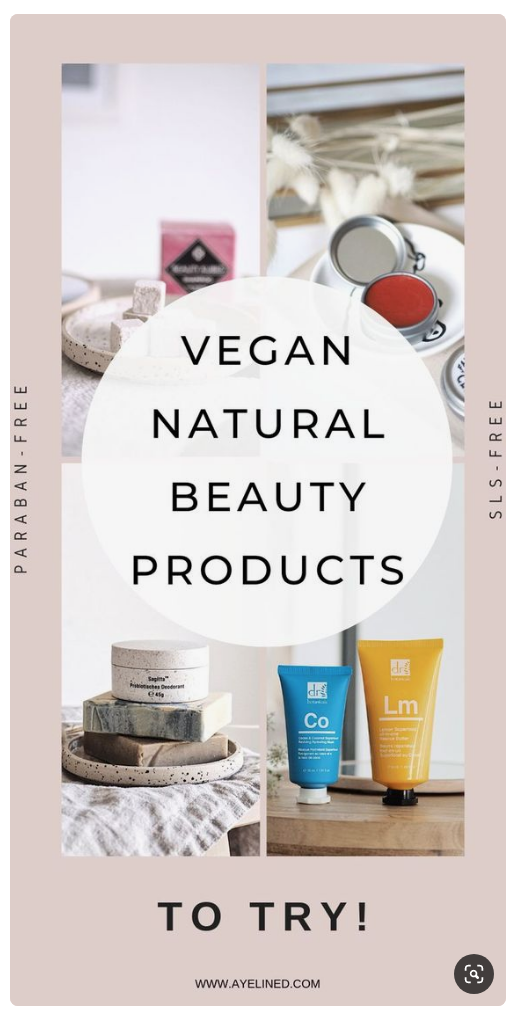
Add Text to your pin images
Adding textual overlays with targeted keywords is another method you can use, like my natural beauty products pin above. Textual overlays provides further context both for the pinner and Pinterest.
Adding a call to action (CTA) can further entice your audience to act. You can place these in textual overlays or in the pin description, I usually place mine at the end of the description. Have a play about with different CTAs to see what works or doesn’t for your audience.
I recommend adding CTAs for people to save your pins as well as visiting your website (eg. find out more! read more!)
Use Google Analytics
If you’ve already built up a bit of traffic from Pinterest you can use this data to analyse what content is working and what isn’t. Is there commonalities between the content that is working? Is it possible to create more of that content? Is certain content doing better depending on time of year? And what content is attracting more engagement?
Have a deep dive into your Google Analytics and see what is working, what isn’t and what can be improved. Use the wealth of data you have to inform you and create better content tailored to your audience.
Add a Call to Action on Your Landing Page
Now you have your ideal audience on your site what do you want them to do? Maybe you want to make a sale so guide them to your items or services (but don’t be overbearing!), or perhaps you want email sign ups.
Whatever it is think about how you can optimise your site to get your end result. Driving traffic from Pinterest is only half the battle, you then have to decide what you want your audience to do when you have them on your site.
To find out more on how to use Pinterest for business see here.
Driving traffic from Pinterest is only half the battle, you then have to decide what you want your audience to do when you have them on your site.
How to use Pinterest to Target Your Audience Summary:
- Get clear about who your ideal audience is and what your brand is about, then create a profile and boards aimed to attract & reflect it.
- If you have boards that don’t currently represent your brand make them secret – even if you get a lot of impressions from the pins inside them.
- Move your most relevant boards to the top of your profile so visitors can quickly see what your Pinterest profile is about and if it’s for them.
- Optimise your profile. Add keywords to your profile, boards and pins that are both reflective of your brand and also what your ideal audiences uses and searches for.
- Use cohesive branding from pin to landing page. Keep the same colours and visual style to create a good user experience.
- Add keyword rich textual overlays to pin images to give further context and appeal to your audience.
- Use Google Analytics to see what people are responding well to and build on it.
- What do you want people to do when you have them on your site? Optimise your site with a Call to Action.
SAVE FOR LATER!
SMALL BUSINESS NEWSLETTER
Get tips directly to your imbox to help you use Pinterest and SEO to grow your business online. You’ll also receive a free Pinterest guide!
Get more inspiration by following my Pinterest account!
Tags: blogging, blogging help, creative business, pinterest, small business


Leave a Reply